 Knowledge hub
 Articles

 8 min read
Understanding the HR Analytics Maturity Model
Understanding an organization’s maturity in HR analytics is crucial for determining how to plan for the future. This is why, years ago, Crunchr developed the very first Maturity Model for HR Analytics. We created this model as a workable solution to scaling adoption throughout the organization. It’s based on a deep understanding of what drives successful adoption and will help your team progress to the next level.
How the Crunchr Model Was Developed
Crunchr’s HR Analytics Maturity Model is rooted in years of research and practical experience. In developing this model, we considered key constructs that influence the adoption and progression of people analytics within organizations:
- Perceived Usefulness: Analytics is valuable to the organization’s strategy and daily decision-making.
- Ease of Use: The analytics tools are intuitive and encourage regular usage.
- Intention to Use: Employees are motivated to leverage insights for better decisions.
- Opportunity to Use: There are opportunities for employees to apply insights in their roles.
- Organizational Readiness: The company culture embraces a data-driven approach across all levels.
These insights, including a survey of more than 125 Crunchr users, helped us create a maturity model outlining the key development stages and the most common barriers organizations face.
The Crunchr HR Analytics Maturity Model
Crunchr’s HR Analytics Maturity Model is a unique framework designed to help organizations assess their current level of maturity and map out the next steps for growth.
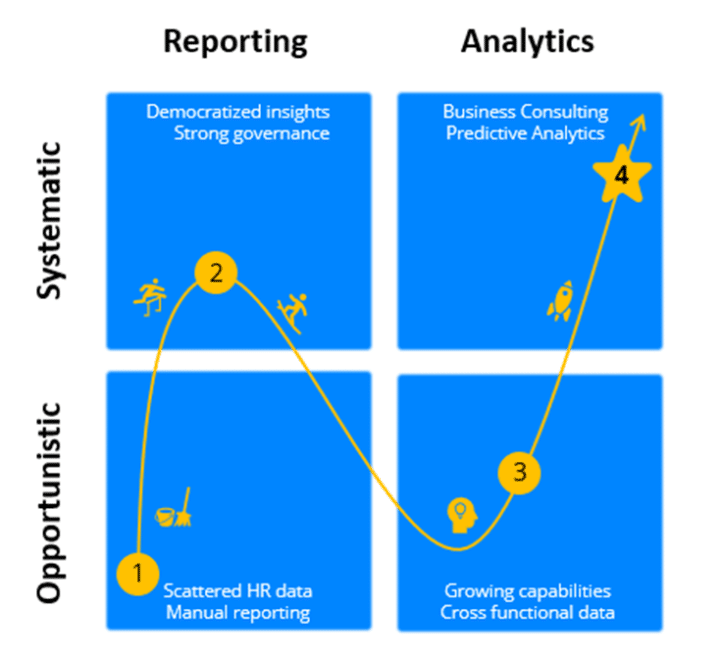
Box 1: Opportunistic Reporting
Most organizations typically start at the opportunistic reporting phase. Normally, there is a single “data person” within the HR team—such as an HRIS specialist, a BI expert from the central data team, or someone else tasked with gathering HR data. This person visualizes initial insights using spreadsheets or basic BI tools.
Common Metrics:
- Headcount
- Hires
- Turnover rates
Key Challenges:
- Inconsistent Definitions: Different definitions are used across reports, leading to reduced trust in insights.
- Capacity Limitations: The report builder becomes overwhelmed as the business demands more slicing and dicing across dashboards.
Pro Tip: To progress from this stage, organizations should invest in centralized reporting tools and create standardized definitions for key metrics.
Box 2: Systematic Reporting
Many organizations are transitioning to—or have already reached—this stage of systematic reporting. At this level, organizations typically employ a small team of HR analytics specialists who create more sophisticated dashboards using BI tools or specialized HR reporting solutions.
Key Characteristics:
- Centralized reporting processes
- Dedicated HR analytics roles
Key Challenges:
- Time Constraints: HR analytics specialists spend most of their time on reporting, leaving little room for deeper analyses.
- Data Security: It is challenging to manage sharing insights in a compliant manner—ensuring users see only the data they are authorized to access.
- Usability Issues: HR professionals struggle to find answers within overly complex dashboards, limiting accessibility and engagement.
Pro Tip: Implement role-based access controls to enhance data security and prioritize creating user-friendly dashboards that address key stakeholder questions.
Box 3: Opportunistic Analytics
Only a minority of organizations are transitioning to—or have reached—the opportunistic analytics stage. Here, the HR analytics team shifts from describing what happened to exploring why it happened. The team often includes analytics translators to bridge the gap with the business and may even hire its first advanced analytics resource.
Key Advancements:
- Integration of data from various sources, including business data
- Increased use of exploratory analyses
Common Use Cases:
- Correlation analyses, such as linking engagement scores with turnover rates
- Early predictive analyses demonstrating how HR can influence outcomes
Key benefit: Self-service reports enable the HR team to conduct independent exploratory analyses, thereby reducing the reporting workload for the core analytics team.
Pro Tip: Encourage cross-functional collaboration to identify key business questions and ensure analytics projects align with strategic objectives.
Box 4: Systematic Analytics
Very few organizations have reached—or are even pursuing—this stage. Large enterprises with substantial HR analytics teams and robust data infrastructures often achieve this phase.
Key Capabilities:
- Comprehensive data integration from HR and business systems
- Proactive workforce planning based on predictive insights
Challenges at This Stage:
- Avoiding “analysis paralysis” by focusing on projects that deliver measurable business impact
The “Holy Grail” of HR Analytics: Organizations at the systemic analytics level excel in genuinely understanding their workforce by answering three key questions:
- What happened?
- Why did it happen?
- What is likely to happen next?
Pro Tip: Establish clear governance structures to prioritize impactful analytics projects and avoid resource-intensive initiatives that do not add value.
Key Transitions Between Maturity Stages
Organizations need to address specific challenges and invest in the right tools to progress through each stage.
Transition Tips:
- From Opportunistic to Systematic Reporting: Implement consistent definitions, centralized dashboards, and scalable reporting structures.
- From Systematic Reporting to Opportunistic Analytics: Invest in data integration tools and upskill HR teams in exploratory analysis.
- From Opportunistic to Systematic Analytics: Enhance data governance and foster a culture of evidence-based decision-making.
Assessing Your Organization’s HR Analytics Maturity
It may sound cliche, but taking a look at how your organization currently operates is essential when considering maturity level.
Consider factors such as:
- How often do you report on critical people metrics?
- The complexity of analytics projects.
- Whether you have self-service tools available.
These factors can help you understand your maturity level better.
Check out Crunchr’s analytics platform to assess your maturity level and identify growth opportunities.
Achieving HR Analytics Excellence
By understanding the four stages of Crunchr’s maturity model (and taking strategic steps to evolve), your organization can tailor adoption strategies to different groups. For example, employees who find the technology useful but have low adoption rates may benefit from targeted training sessions relevant to their specific roles.
So there you have it; you’re one step closer to getting that holy grail of HR analytics maturity: systematic analytics. What’s next? Let us help you assess your HR analytics maturity so you can tap into the heartbeat of your organization. Discover how Crunchr can support your journey today.
The HR Analytics Maturity Model describes how HR teams evolve from basic workforce reporting to advanced, decision-driven people analytics. It helps organizations understand where they currently stand and what practical steps will move them toward more strategic workforce insights.
Most initiatives stall because teams wait for “perfect” data before moving forward. This creates a permanent preparation phase, where insights are delayed even though existing data is already good enough to support meaningful decisions.
No. HR analytics does not require perfect data. What matters is whether the data is good enough for the decision you’re trying to support. Many strategic HR questions can be answered reliably with incomplete but representative data.
Data quality improves in parallel with analytics maturity. As HR teams actively use data, gaps, inconsistencies, and definitions become visible, creating a natural prioritization for improvement rather than a one-off clean-up project.
Most organizations can start with core HRIS data: employees, roles, reporting lines, locations, and key dates like hire and exit. Additional sources such as payroll, ATS, engagement, or learning data can be added progressively when they increase decision value.
Very important. Misaligned definitions—such as headcount, turnover, or FTE—can undermine trust in analytics. The goal isn’t to finalize every definition upfront, but to align on the metrics that matter most for current decisions and make those definitions transparent.
Trust comes from visibility and context, not perfection. By clearly showing where data is complete, where it isn’t, and how representative it is, HR teams can explain results confidently and responsibly in leadership discussions.
For many internal HR decisions, around 90% statistical confidence is sufficient. Depending on company size, this often requires far less data than expected—as long as the data is reasonably representative of the workforce.
Crunchr supports maturity by making data quality issues visible inside the analytics environment itself. Teams can assess completeness, plausibility, and consistency while analyzing workforce trends, allowing insights and data quality to improve together.
No. The maturity model applies to organizations of all sizes. Smaller companies often reach meaningful insights faster because fewer systems and stakeholders are involved, as long as they focus on the right questions rather than perfect data.
 Share on X
 Share on Facebook