 Knowledge hub
 Articles


 8 min read
Key Takeaways
- Next year’s workforce plan should reflect where this year’s assumptions fell short.
- Review roles, skills, workforce risks and structure alongside headcount.
- Compare baseline, growth and downside scenarios, each with a cost attached.
- Bring Finance the reasons behind the numbers and the changes they call for.
There is a real itch to open last year’s workforce plan, adjust the numbers for the coming year, and move on. That’s until someone asks why. Why so many roles? Why does the cost per person go up if the headcount is the same?
Trust us, don’t scratch it.
Simply rolling forward last year’s numbers gives you a headcount target, not a workforce plan.
Strategic workforce planning answers whether you have the right people, skills, and structure for what the business is committing to next year, at a cost you can defend.
A credible workforce plan starts with the evidence about what has changed, what the business will need, and which risks the current workforce carries into next year. Below are five reviews that get you there.
The Workforce Planning Checklist: Five Reviews
1. Current workforce reality
Start with what the workforce looks like today, and where that differs from what this year’s plan assumed.
- Compare headcount and FTE by team against what was budgeted for that team, since the organization-wide total can look fine, while individual teams are well off plan
- Measure planned against actual hiring, leavers and internal movers over the past year, and identify how large those gaps are
- Separate backfill from new roles in last year’s hiring, since Finance reads growth and replacement very differently
- List the definitions that would undermine any comparison. Think job titles that mean different things across systems, cost centers that don’t map to the current org chart, or a definition of headcount that HR and Finance don’t share. Treating data quality as an ongoing project rather than a blocker is usually a lot faster than waiting for clean-up projects to finish.
How this prepares you for budget discussions
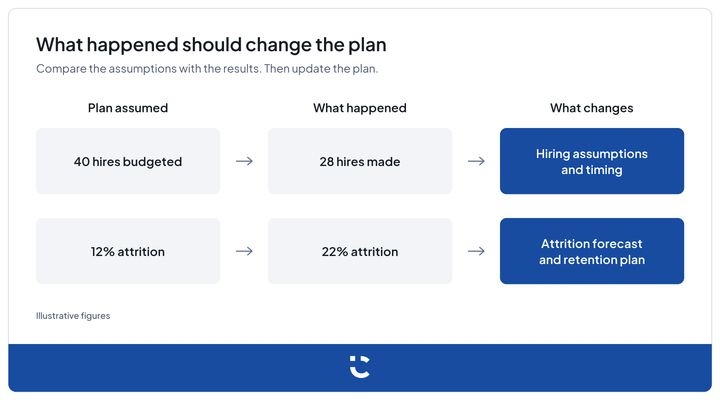
The gap between last year’s plan and what happened is the number that shapes next year’s plan. Budgeting for 40 and then making 28 hires signals that at least one underlying assumption did not hold, whether around hiring capacity, role urgency, approvals, compensation, or talent availability.
Understanding the reason changes what you ask for this time, and makes your request easier to assess.
2. Future workforce demand
Work out what the strategy actually needs next year: which roles, which skills, and when.
- Split the strategy into parts that need new capacity and parts that need new capability, since growth in one region rarely calls for the same mix of roles as growth in another
- Name the roles the plan assumes will exist that don’t exist yet, and who owns building that job family
- Identify the skills the plan depends on, but which the organization does not currently track. CIPD’s Resourcing and Talent Planning Report found that only 38% of UK organizations collect data to identify the skills gap
- Check assumed start dates against how long similar roles actually took to fill last year
- Identify the share of work AI or automation is expected to absorb next year, and whether that assumption has actually been tested anywhere in the business.
How this prepares you for budget discussions
Start dates are an assumption like any other, and need to be realistic. If similar roles took an average of four months to fill last year, roles expected to start in Q4 need to be opened well before Q4. Otherwise, their cost and capacity should be planned for the following year.
Phasing it that way from the outset avoids ending the year with a budget you asked for and didn’t use, which tends to get read as roles you didn’t need.
3. Workforce risk
Find the places where the plan depends on people who could leave.
- Find the client relationships or specialist knowledge concentrated in a single role with no one else able to cover it
- Assess retention risk by group rather than by individual. Forecasting at the level of the roles the strategy actually depends on holds up better than an organization-wide average or an individual flight-risk score
- Calculate what it would cost to replace that group, internally or externally. In the same CIPD survey, only around one in five organizations looked at this.
How this prepares you for budget discussions
You can put a price on keeping people, rather than asking for a retention budget and hoping. If a handful of people hold the client relationships in one part of the business, and replacing them costs more than keeping them, that comparison is something Finance can act on.
4. Organizational structure
Look at how the organization is put together: how many managers, how many layers, and what that costs.
- Check span of control by manager, and whether an average that looks fine is hiding a handful of managers well outside it. Span is better tracked continuously rather than audited periodically, which makes the check faster than it sounds
- Count the layers between the front line and leadership that accumulated without anyone deciding to add them
- Test whether average cost per employee is rising because you are hiring more senior people, or hiring in more expensive locations, rather than because headcount grew.
How this prepares you for budget discussions
You can say why the average cost per person went up. It may be because the people joining are more senior or sit in more expensive locations than the ones who left. That is a different conversation from headcount growth, and it needs a different answer.
5. Scenarios and cost
Build more than one version of the plan, each with a cost attached.
- Build a baseline case, a growth case, and a downside case, each with headcount and cost attached
- Break each scenario’s costs down by cost centre, since an aggregate headcount change can hide which teams actually carry the cost
- Decide which roles you would pause first in a downside case, and what would have to happen before hiring starts
How this prepares you for budget discussions
The budget gets cut, and someone has to say which roles go. If you don’t, then the cut lands evenly across every team. That looks fair, and it ignores what each team was hiring for. Bring your own version instead: the roles a team can manage without for a while, and the roles that stop something the company has already committed to.
The best way to defend the budget is to own it
Most budget conversations come down to two questions: did last year’s plan hold and what does this year’s plan assume?
Answer those well and you spend the meeting working through specific workforce assumptions with finance and the rest of the leadership, rather than defending whether the plan can be trusted.
To do this, you need to keep it specific. A plan that assumed 12% attrition in customer success and got 22% is a corrected assumption, and you should be the one raising it. Or perhaps five budgeted data engineer roles are still open at year-end.
A 3-step checklist for a tight schedule
In case you’re short on time, there is a smaller job that still helps, and is quicker than the full checklist. Plus it is usually enough to tell whether the next year’s plan is built on evidence or purely based on last year’s numbers.
Put this year’s approved plan next to what actually happened. Pick the three biggest differences. Then decide which assumptions behind next year’s draft plan have to change because of them.
The checklist
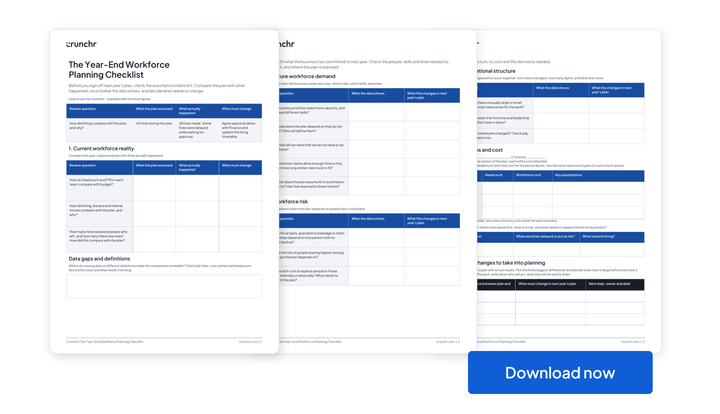
The printable version below turns the five reviews into questions, with space to compare plan and actuals, record findings, and decide what needs to change. It also includes a scenario comparison and a final section for your three priorities, next steps, owners and dates.
Get your copy of the Crunchr Workforce Planning Checklist (PDF) →
FAQ
Five areas: current workforce versus plan, future roles and skills, workforce risks, organizational structure, and scenarios with their costs. The result should be a clear set of changes to next year’s plan.
Headcount planning focuses on how many people are needed, when and at what cost. Workforce planning also considers the skills, structure and ways of working needed to deliver the business strategy.
Explain the biggest differences between this year’s plan and actual results, then show how they change next year’s assumptions. Bring realistic hiring dates, costs by team, and alternatives if the budget changes.
Update the assumptions that no longer hold, such as hiring timelines, expected attrition or workforce costs. Turn the findings into specific changes to the plan, with an owner and a deadline for each.
 Share on X

 Share on Facebook